 By David Pike
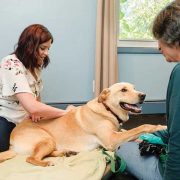
Veterinary medical massage occupies an interesting place in the history of animal medicine. People have rubbed, manipulated and stretched the muscles of working animals for centuries, particularly horses, but massage entered formal veterinary practice much later. The techniques themselves came largely from human medicine and physiotherapy. What changed over time was the context around them, as a better understanding of anatomy and biomechanics, the growth of veterinary rehabilitation, formal training for practitioners and eventually the rise of integrative veterinary medicine all reshaped what massage was for and who was doing it.
Modern veterinary medical massage grew out of several traditions that began to overlap during the twentieth century. Equine sports medicine drew attention to muscular performance. Human physiotherapists started adapting rehabilitation techniques for animals. Veterinarians grew more interested in physical rehabilitation after orthopedic and neurologic injuries, and acupuncture, manual therapy and other complementary approaches gradually found their way into veterinary hospitals and university programs. The result was a slow shift from informal animal bodywork into a clinical discipline, where massage could be chosen as one part of a larger treatment plan rather than a stand-alone remedy.
The Practice Started With Human Medicine
Most of the techniques used in veterinary massage were developed for people first. Massage appears in medical traditions going back thousands of years, but the version recognizable in modern Western practice came together during the nineteenth century, when European physicians and physical therapists built out systems of manual treatment involving rubbing, kneading, percussion, joint movement and therapeutic exercise. Effleurage, petrissage, friction and tapotement became standard terms in human massage and physiotherapy during that period.
Animal practitioners later borrowed heavily from that foundation. VCA Canada describes veterinary massage as a fairly recent adoption within veterinary medicine, one that draws extensively on human massage technique. Trigger-point work, friction massage and other manual approaches moved into animal care as veterinarians and rehabilitation professionals began applying human physical-therapy concepts across species.
Horses were the obvious place to start. Their muscular systems are easy to palpate, subtle restrictions can visibly affect athletic performance, and racing and competitive equestrian sport created strong practical incentives to keep animals moving efficiently. Long before massage became common in small-animal rehabilitation, horse trainers and therapists were already paying close attention to muscle soreness, flexibility and recovery.
Equine Sports Medicine Helped Push Massage Forward
The rise of equine sports medicine gave manual therapy a more defined role during the twentieth century. Horses competing in racing, jumping, dressage and other demanding disciplines were athletes in every practical sense, and the people responsible for them started approaching muscular conditioning and recovery much the way trainers approached human athletes.
Massage began to move beyond the traditional post-exercise rubdown as practitioners started evaluating specific muscle groups, tension patterns and movement restrictions that might affect performance, adapting techniques from human sports massage to equine anatomy. Jack Meagher became one of the better-known figures from this period. He had worked with human athletes before applying sports massage principles to horses, developing a method built around identifying muscular “stress points.” His work during the 1970s and 1980s helped popularize a systematic approach to equine sports massage and introduced the idea that hands-on soft-tissue assessment could be useful before an obvious injury ever showed up.
Equine work also helped establish a concept that later became important throughout veterinary rehabilitation, which is that muscles and fascia deserved clinical attention alongside bones and joints.
Animal Physiotherapy Begins to Take Shape
Another strand of the history developed through physiotherapy, with early roots in Britain. Canadian professional sources trace an important episode to 1939, when British physiotherapist Charles Strong was asked to use electrical muscle stimulation on two lame polo ponies belonging to Lord Louis Mountbatten. Strong reportedly became a strong advocate for applying physiotherapy to animals after seeing the improvement. His student D.M. Winks Greene went on to treat equine musculoskeletal problems and eventually founded Britain’s Association of Chartered Physiotherapists in Animal Therapy in 1984.
Massage fit naturally within this expanding field because human physiotherapists already had training in manual therapy, therapeutic exercise and physical rehabilitation. When those clinicians started treating animals, they brought a structured understanding of movement, muscle function, joint mobility and recovery along with them.
Veterinary rehabilitation stayed a fairly small field for most of the twentieth century. VCA’s historical overview places significant growth in the late 1980s and early 1990s, when individual rehabilitation therapies began receiving more research attention and formal recognition within animal medicine. Massage became one of several physical modalities used alongside therapeutic exercise, heat and cold therapy, electrical stimulation, ultrasound and later hydrotherapy and laser treatment, and those developments gave veterinary massage a real clinical home for the first time.
Canada Became an Early Center for Animal Physiotherapy
Canada deserves a meaningful place in this history, though its contribution came through rehabilitation and professional education rather than any single defining discovery about massage itself.
Canadian physiotherapists were already treating animals during the 1980s. In 1993, a small group of Alberta physiotherapists working mostly with horses organized formally and created the Canadian Horse and Animal Physical Therapists’ Association, which later became the Animal Rehab Division of the Canadian Physiotherapy Association.
Calgary physiotherapist Laurie Edge-Hughes became one of the important figures in the next stage of this story. She began working with animals in 1993 after graduating in physical therapy from the University of Alberta, founded an animal rehabilitation practice in Alberta, and went on to teach the first canine physiotherapy courses in Canada in 1999. She taught early canine physiotherapy courses in the United States that same year and in Australia in 2001.
Her importance extends beyond massage on its own. Physiotherapists entering animal care brought manual therapy into a broader assessment model, where massage, stretching, joint mobilization, myofascial technique and therapeutic exercise could all be chosen based on the animal’s movement, musculoskeletal condition and rehabilitation goals rather than applied by default. Canadian animal physiotherapy organizations still include massage and myofascial work among the manual-therapy techniques used by appropriately trained practitioners today.
Ontario also produced an early leader in integrative veterinary rehabilitation. Dr. Janice Huntingford, a 1984 graduate of the Ontario Veterinary College at the University of Guelph, built a career spanning canine rehabilitation, acupuncture, pain management, chiropractic and herbal medicine, and in 2007 opened Ontario’s first saltwater canine therapy pool and canine rehabilitation center. Her career reflects the direction the field was already taking, where rehabilitation and manual therapies were increasingly combined with other veterinary disciplines instead of developing in isolation.
Small-Animal Rehabilitation Changed the Field
Horses dominated much of the early development of animal massage and physiotherapy because of their role in sport, but dogs eventually changed the scale of the field. Advances in veterinary orthopedic surgery created more animals needing structured postoperative rehabilitation. Dogs were living longer, which brought more attention to osteoarthritis, mobility loss and chronic musculoskeletal problems, and canine athletics expanded alongside all of this, creating another population where strength, flexibility and recovery mattered.
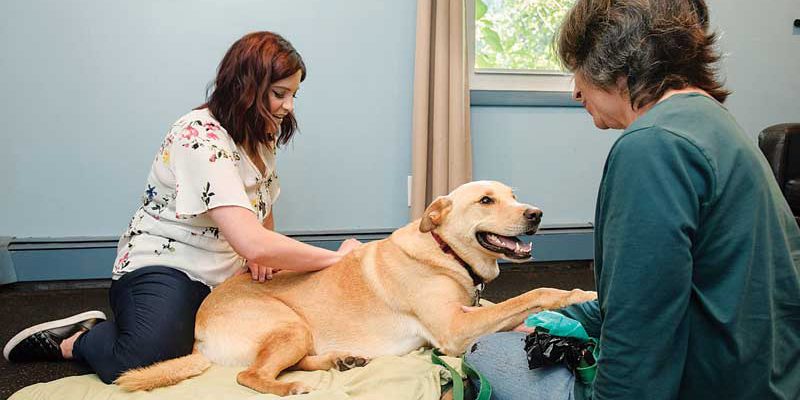
Veterinary rehabilitation programs started appearing more regularly during the 1990s and 2000s, and massage could now be used within a treatment plan alongside therapeutic exercise, hydrotherapy, joint mobilization and other modalities. Practitioners were increasingly expected to understand the animal’s diagnosis, anatomy and movement rather than run through a predetermined massage routine. VCA Canada describes contemporary veterinary massage specifically as a form of rehabilitation involving hand movements intended to address restrictions affecting muscle and joint function, and specialized training became more important as the practice moved closer to veterinary medicine and rehabilitation proper.
Demand for medical massage training for vets grew directly out of that shift. Veterinarians who already understood pathology and animal anatomy wanted hands-on techniques they could fold into their existing diagnostic and treatment skills.
Integrative Veterinary Medicine Gave Medical Massage a Larger Framework
The rise of integrative veterinary medicine during the late twentieth and early twenty-first centuries changed the position of massage again. “Alternative medicine” had traditionally meant choosing another treatment instead of conventional medical care. Integrative medicine worked on a different model, where complementary treatments could be folded into conventional veterinary diagnosis and treatment when their risks, potential benefits and evidence supported doing so.
A 2016 consensus paper on integrative veterinary education defined integrative veterinary medicine as combining complementary therapies with conventional care while using the best available evidence, and the authors identified physical rehabilitation among the common areas being added to veterinary curricula, alongside acupuncture, manipulative therapy, nutrition and herbal medicine. By 2021, a survey of AVMA-accredited veterinary colleges found that 76.7% of responding institutions offered some level of integrative veterinary medicine instruction and 74.4% offered clinical IVM services, with rehabilitation and acupuncture among the most commonly taught subjects.
Massage got easier to understand within this framework. A veterinarian might combine conventional diagnostics and medication with rehabilitation, acupuncture, photobiomodulation and hands-on soft-tissue treatment depending on the patient, rather than presenting massage as a competing philosophy of medicine. It could simply be another physical modality inside a multimodal plan. A major veterinary textbook published by Wiley in 2023 shows how far the discipline has come. Integrative Veterinary Medicine, edited by Mushtaq Memon and Huisheng Xie, devotes an entire section to manual therapies and a chapter specifically to massage therapy and myofascial principles, sitting alongside rehabilitation, acupuncture, nutrition and botanical medicine in the same evidence-oriented clinical reference.
Canada Has Also Moved Integrative Medicine Into the Professional Mainstream
Canada’s current professional position shows how far perceptions have shifted since animal physiotherapists first started organizing in Alberta. In February 2026, the Canadian Veterinary Medical Association formally described integrative veterinary medicine as veterinary care combining conventional medicine with researched, science-based complementary approaches, listing massage therapy, myofascial release, rehabilitation and sports medicine, acupuncture and photobiomodulation among them.
The CVMA also stresses veterinary supervision, scientific evidence and an established veterinarian-client-patient relationship, while provincial and territorial regulators determine which procedures count as veterinary medicine and what work can be delegated to appropriately trained allied health professionals. It’s a significant change from where things started. Massage moved from informal animal bodywork into an area a national veterinary organization now discusses within the same professional framework as other forms of integrative veterinary care.
Veterinary Medical Massage Training Becomes More Formal
Education followed the development of the field. Early animal massage knowledge passed along through apprenticeships, equine practitioners and techniques borrowed from human massage. The growth of rehabilitation created demand for more structured teaching in anatomy, palpation, biomechanics and clinical decision-making, and modern veterinary medical massage courses increasingly teach practitioners how soft tissue interacts with joints, nerves, movement and the rest of the musculoskeletal system.
The terminology shifted along with the training. “Animal massage” can describe a wide range of hands-on work, while medical massage puts more weight on anatomy, clinical assessment, indications, contraindications and the reasoning behind a given technique. CuraCore’s veterinary medical massage courses represent this newer stage of the field. Its Osteopathic Medical Massage for Small Animals program combines massage with anatomy, physiology, myofascial release, balanced ligamentous tension, palpation and movement evaluation, designed for veterinary professionals, students and technicians through a mix of online education and hands-on clinical instruction.
Programs like these reflect a broader change in integrative veterinary education, where practitioners are expected to understand why a tissue is painful or restricted, how that finding connects to the animal’s diagnosis and biomechanics, and how manual treatment fits alongside the rest of veterinary care.
A Practice That Grew Up Alongside Veterinary Rehabilitation
Veterinary medical massage didn’t come from a single discovery or one person. It came together gradually, out of several traditions running in parallel. Human medicine supplied centuries of manual-therapy knowledge. Equine sports medicine showed the value of paying close attention to muscular performance. Physiotherapists brought systematic rehabilitation principles into animal care. Veterinarians began working physical rehabilitation into orthopedic, neurologic, geriatric and sports-medicine cases, and integrative veterinary medicine eventually gave manual therapy a framework for sitting alongside conventional diagnosis and other evidence-informed treatments.
Canada played a particularly interesting role in that progression. Canadian physiotherapists organized around animal rehabilitation as early as 1993, Laurie Edge-Hughes helped build formal canine physiotherapy education starting in 1999, and veterinarians like Janice Huntingford helped establish multidisciplinary rehabilitation and integrative practices. Today the Canadian Veterinary Medical Association explicitly recognizes massage therapy and myofascial release among the modalities used within integrative veterinary medicine. Underneath all of that is a change in how veterinary medicine thinks about touch. What began largely as rubbing sore muscles and helping working animals recover gradually became more anatomically precise, more clinically organized and more closely tied to rehabilitation medicine. Modern medical massage for vets continues that progression by bringing hands-on treatment into the same clinical reasoning process veterinarians already use for the rest of the patient.